
Your Burning, Swollen Feet Are Not Just Age Or 'Nerve Damage'. Meet The Real Culprit (It Is Not In Your Feet)


You know the routine.
Your feet are bearable during the day. Then you get into bed, and they start.
The soles burn. The toes tingle with pins and needles. Some nights they are numb and ice cold to the touch, and burning at the same time. The sheet resting on them is too much, so you sleep with your feet outside the covers.
And when you look down in the evening, your ankles are puffy and the bones have disappeared.
You did what you were told.
You took the pills. You rubbed in the creams. You soaked your feet. You bought the cushioned shoes and the foot massager from the catalog.
And the next night, your feet burned again.
That is not a failure of effort.
It is what happens when everything you have tried is aimed at the wrong part of your leg.
Because in a great many people over 55, feet that burn, tingle and go numb are not starting in the feet at all, and "it's just your age" is not an explanation.
The cause has a location. It sits about four inches above your sole. And in 23 years as a foot care nurse, I watched almost everyone, including me, look straight past it.
I'll show you exactly where it is in a moment.
But first, there is something you need to stop doing.
STOP TREATING YOUR FEET

If you have been rubbing cream into your soles, soaking your feet, or rolling them over a massager every evening, I want you to notice one thing before you read any further.
It helps for about twenty minutes.
The cream cools the skin, and then the burning comes back. The warm soak feels good, and by the time you are in bed your feet are cold again. The massager makes the soles tingle less while it is running, and not after.
That pattern tells you something.
If the trouble were in the skin or the sole of the foot, something you put on the skin or the sole would hold. It does not hold, because the foot is where you feel the problem. It is not where the problem is.
Your foot does not make its own blood supply. Everything it needs arrives from higher up the leg, and all of it comes in through one narrow place.
Nobody showed you that place.
That changes right now.

My name is Ruth Halvorsen, RN. I was a foot care nurse for 23 years. I have looked after thousands of pairs of feet that burned, tingled and went numb. And at 61, lying awake with my own feet on fire, I found out what all of us had been missing.
THE NIGHT MY OWN FEET STARTED

For most of my career I ran a foot care clinic for older patients. A dozen times a day someone sat in my chair and described the same thing: burning soles at night, pins and needles in the toes, numb patches, ankles that puffed up by supper.
I did what I was trained to do. I checked the skin. I trimmed and padded. I recommended a cream, a soak, a better shoe. And I said the sentence I had heard doctors say a thousand times:
"It's neuropathy. It comes with age. We manage it."
Then the patient came back three months later with the same feet.
Then it happened to me.
At 61 my own feet started. First a tingle in the toes when I sat down in the evening. Within a year, a burning across both soles that woke me at two in the morning. I slept with my feet out of the covers in January. My ankles were thick by the end of every shift.
I knew every product on the shelf, so I tried all of them. The capsaicin cream. The menthol gel. The soaks. Two different foot massagers. My doctor offered me a nerve pill, and told me, kindly, that there was not much else to do.
Each of them gave me twenty minutes.
That is when I stopped looking at my feet and started looking at what feeds them.
I was a nurse. I had been taught the anatomy of the lower leg. I had simply never been asked to connect it to the patients in my chair.
WHAT IS ACTUALLY HAPPENING ABOVE YOUR FEET

Here is the part that almost nobody explains, and it takes two minutes.
Your foot is the part of your body furthest from your heart. Blood has to travel the full length of your leg to reach it, and then travel all the way back up.
Every artery that carries blood into your foot passes through your ankle.
Every vein that carries it back out passes through your ankle.
Every nerve that gives your foot its feeling passes through your ankle.
There is no other route. The ankle is the narrowest part of the leg, and all of it runs through there, packed between bone, tendon and skin.
When the small blood vessels at the ankle are open and the tissue around them is soft, your feet are warm, pink and quiet.
When they are not, this is what happens:
The small vessels at the ankle narrow. Less blood gets through to the foot. The tissue around the ankle holds fluid, swells and stiffens, and that presses on the same vessels and nerves. The nerves in your foot, which need a steady supply of oxygen to work, begin to run short.
A nerve that is short of blood does not go silent straight away. First it misfires. That misfiring is the burning, the tingling, the pins and needles.
If it stays short of blood, it starts to go quiet. That is the numbness, and the feet that feel cold even under a blanket.
I call it Ankle Blood Starvation.
Doctors talk about poor microcirculation in the lower leg, and it is far more common than most people realise once you are past 55.
It explains every part of your night. Worse in bed, because your heart slows when you lie down and even less blood is pushed to the far end of your legs. Cold toes and burning soles together, because both are what a nerve does when it is short of blood. Puffy ankles by the evening, because the fluid has been collecting there all day.
None of that starts in the sole of your foot. All of it starts at the ankle, where the supply comes in.
WHY IT SHOWS UP AFTER 55

Small blood vessels lose their stretch with age. By your late fifties they do not open as wide as they once did, and the smallest ones, at the far end of the leg, are affected first.
At the same time, most of us walk less than we used to and sit more. A still ankle moves very little blood through it. Fluid that should be carried back up the leg stays where it is.
Narrower vessels. A stiller ankle. More fluid sitting in the tissue.
Here is why the usual advice fails:
- Creams work on the skin of the foot. The narrowing is above the foot, and under the skin.
- Soaks warm the foot for as long as it is in the water. Ten minutes after you dry off, the foot is as cold as before.
- Foot massagers work on the sole. The sole is where the supply ends, not where it comes in.
- Nerve pills turn down how much you feel. They do not send any more blood to the nerve.
Nothing on that list does anything at the ankle.
But something does. Foot care nurses and physical therapists have used the three parts of it, one at a time, for decades.
Until recently, nobody had put all three in one place and aimed them at the right spot.
THE THREE THINGS A STARVED ANKLE RESPONDS TO

Warmth. Small blood vessels open when the tissue around them is warmed. It is the reason a warm towel around the ankle was the first thing I reached for in the clinic. Open vessels let more blood through to the foot.
Red light. Light at a wavelength of 660 nanometers passes through the skin and reaches the tissue underneath it. It is the same wavelength used in red light panels in physical therapy offices, and it is applied directly over the area being worked on.
Vibration. Gentle vibration moves the fluid that has collected in swollen tissue, and it is how a therapist's hands work on a stiff, puffy ankle.
The first time I did all three on my own ankles, on the same evening, for twenty minutes, my feet were warm when I got into bed. I had not felt that in a year.
The problem was how I had to do it. A heating pad that slid off. A borrowed light panel propped on a stool. A hand-held massager I had to hold in place. Three cords, twenty minutes, one ankle at a time.
For this to be something you do every evening, it has to do THREE things:
REACH THE ANKLE: wrapped right around the joint, where the vessels and nerves pass through. Not under the sole, and not on the calf.
DO ALL THREE AT ONCE: warmth, red light and vibration together, on the same spot, in the same twenty minutes.
STAY ON BY ITSELF: no cords, nothing to hold, nothing to prop up, so you can sit in your chair and watch television while it works.
Miss any ONE of those and it ends up in the closet with the foot massager.
So we built the one thing that does all three.
INTRODUCING THE ANKLERA RED LIGHT ANKLE WRAP

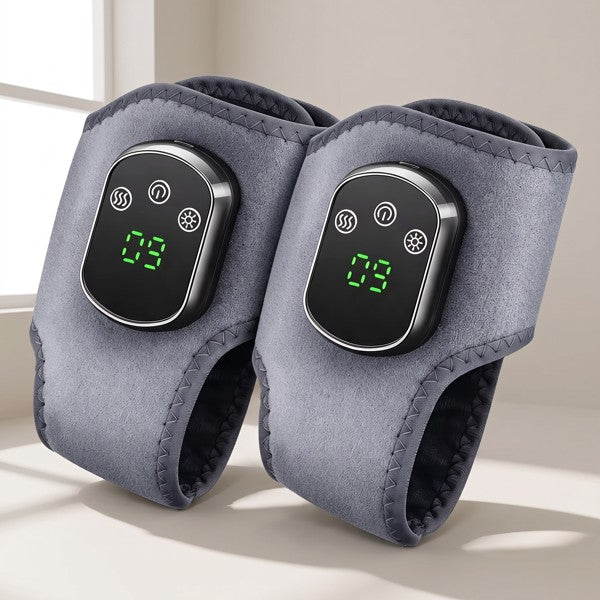
Anklera is a soft, cordless wrap that fastens around your ankle and delivers warmth, 660nm red light and vibration to the exact place your foot's blood supply and nerves pass through.
You wrap it on. You press one button. You sit back for twenty minutes.
✓ 40 RED LIGHT BEADS AT 660NM: forty beads line the inside of the wrap and sit directly against the ankle, on both sides of the joint.
✓ FIVE HEAT LEVELS, 104°F TO 140°F: from gentle warmth to deep heat. You choose the level on the display, and you can change it at any time.
✓ THREE VIBRATION MODES: a steady vibration through the whole wrap that works on puffy, stiff tissue while the heat and light are on.
✓ 20-MINUTE AUTO SHUT-OFF: it counts down on the display and turns itself off. Fall asleep in your chair and it has already finished.
✓ CORDLESS AND RECHARGEABLE: a built-in battery that charges with the USB-C cable in the box. No outlet next to your chair, no cord across the floor.
✓ ONE SIZE, EITHER ANKLE: soft grey fabric with a wide stick-on strap. It fits the left or the right, and you tighten it to where it feels snug.
✓ THREE BUTTONS AND A DISPLAY YOU CAN READ: power, heat, vibration. That is the whole instruction manual.
You sit down after supper. You wrap one on each ankle. You press the button. You watch your program.
No appointments.
No cords.
No greasy sheets.
No basin of water to carry across the kitchen.
WHAT PEOPLE NOTICE

When something takes twenty minutes in your own chair and asks nothing of you, you do it. And when you do it every evening, here is what people describe.
The first evening: warm feet at bedtime. Most people notice it when they take the wraps off. Ankles and feet that are warm to the touch, and still warm when they get under the covers.
The first week: quieter nights. Many people tell us their feet stay under the blanket again, and that they are sleeping through the hour that used to wake them.
The first weeks: ankles with a shape. People who wrap in the evening describe looser, less puffy ankles and shoes that go on more easily the next morning.
After that? It becomes the twenty minutes of the evening they look forward to.
Individual experience varies, and the people below are describing theirs.
WHAT PEOPLE ARE SAYING


"I'm 71 and I had slept with my feet out of the covers for four years. I put these on during the evening news, both ankles. The second week I woke up and realised my feet had been under the blanket all night."
"Nobody in ten years ever looked at my ankles. It was always the feet. The explanation made more sense to me than 'it's your age' ever did. My husband has taken to borrowing one, so I ordered him his own pair."
"68. Pins and needles in both feet and ankles like softballs by supper. I use heat level three and the middle vibration. It shuts itself off, which is good, because I am usually asleep in the recliner by then. My boots go on in the morning."
"Retired after 30 years on my feet in a hair salon. I had a drawer full of creams and a foot spa in the garage. This is the first thing I have used every single night. No cord, one button, and my feet are warm when I go to bed."
WHAT TREATING YOUR FEET HAS ALREADY COST YOU

Let me show you what the usual route costs, because I recommended it to people for 23 years.
The Cream And Soak Route:
- Nerve creams and gels: $20 to $40 a tube, a tube or two a month
- Soaks, cushioned insoles, special socks
- Total: $300 to $600 a year, for twenty minutes of relief at a time
The Gadget Route:
- A plug-in foot massager or foot spa: $80 to $250
- Heavy, corded, and aimed at the sole of the foot
- Most are in a closet within three months
The Clinic Route:
- Red light sessions at a therapy office: $40 to $90 a visit
- Two or three visits a week to keep it up
- And a drive there and back each time
I am not telling you your doctor was wrong. Your doctor treated what you described, and what you described was your feet. Nobody looked four inches higher.
The regular price for two Anklera wraps is $178.
But that is not what you will pay today.
WHY WE SEND TWO WRAPS, AND CHARGE FOR ONE
You have two feet, and they almost never burn one at a time.
In the clinic, people who were given something for one side used it on one side, swapped it over halfway through the evening, and gave up within a fortnight. Forty minutes is too long. Twenty minutes, both ankles at once, is something people keep doing.
So the offer on this page is a pair. Buy one wrap, and the second wrap is free.
Today that is $89 for two wraps. $44.50 a wrap.
- Less than TWO red light sessions at a therapy office.
- Less than the foot massager in your closet.
- Less than three months of creams.
For warmth, red light and vibration on both ankles, every evening, in your own chair.
LOOK, I UNDERSTAND THE SKEPTICISM
You have been down this road. You have a cupboard of things that were supposed to help. You have been told "it's just your age" by people with diplomas on the wall.
So here is my promise, and it is the only promise on this page:
Use them for 90 days. If you are not glad you bought them, email us and we refund every penny.
- No forms.
- No "store credit".
- No questions you do not want to answer.
Why am I comfortable making that offer? Because warmth, red light and gentle vibration are not new or strange. Therapists have used each of them for decades. All we changed is that they now arrive together, at the ankle, without a cord.
Support: support@anklera.com
BUT HERE'S THE CATCH
The buy-one-get-one pricing on this page is for readers of this article, and we review it every week based on stock.
Our current batch is 3,000 wraps. Each one has forty light beads, a heating layer, a vibration motor and a rechargeable battery inside it, so a batch takes weeks to make, and the colder months are when they go fastest.
We do not sell on Amazon. This page is the only place the two-wrap pricing exists.
If you are reading this, the two-wrap pricing is still available.
I cannot promise it will be tomorrow.
And here is the thing...
Every day you wait is another day:
- The small vessels at your ankles stay narrow
- The nerves in your feet run short of blood for another night
- You lie awake at two in the morning with your feet outside the covers
While twenty minutes in your chair, on both ankles, costs $89 for the pair.
THE CHOICE THAT DECIDES WHAT YOUR FEET FEEL LIKE AT 2 AM
Right now, you are at a fork.
Path #1: Keep Treating Your Feet
Keep rubbing in the cream, filling the basin and plugging in the massager. Keep getting twenty minutes. Keep hearing "it's just your age".
Path #2: Go To Where The Supply Comes In
Spend less than two clinic sessions on a pair of wraps, put them on your ankles for twenty minutes each evening for a week, and notice what your feet feel like when you get into bed.
The choice seems pretty obvious to me.
HERE'S EXACTLY WHAT TO DO NEXT
- 1. Click the button below that says "Check Availability Now →"
- 2. Choose your pack. (Most people choose the pair: one wrap for each ankle.)
- 3. Fill in your shipping details. Orders ship within one business day.
- 4. When they arrive, charge them with the cable in the box, wrap one around each ankle and press the power button.
- 5. Feel your feet when you get into bed. Then email us and tell us what you noticed. We read every one.
But whatever you do, don't close this page thinking "I'll order later."
Later is another night with your feet out of the covers.
Later is another tube of cream.
Later is this batch being gone.
Your feet were never the place to start. Your ankles are.
Click below and wrap them.
READER OFFER
FOR A LIMITED TIME:
BUY ONE WRAP, GET ONE WRAP FREE + FREE US SHIPPING
LIMITED TIME READER-ONLY SPECIAL:
Ordering from this page gets you two wraps for $89, free US shipping, and the 90-day money-back promise above.
With respect, and warm feet,
Ruth Halvorsen, RN
Foot Care Nurse (retired), Anklera
P.S. I wrap both ankles every evening at eight, heat level three, during my program. My feet have been under the covers all winter.
P.P.S. Try this tonight. Put the back of your hand on your shin, then on the top of your foot. If your foot is clearly colder than your shin, less blood is reaching it than should be, and you already know where it has to pass through to get there.
P.P.P.S. The two-wrap pricing is reviewed weekly against stock. The button below is the only place it exists.