
The Rash Under Your Breasts Is Not Heat Rash, And It Is Not Poor Hygiene. It Has A Name (And Powder Is Making It Worse)


You know exactly where it is.
Under your breasts, along the line where your bra band sits. Or in the crease under your belly. Or at the top of your thighs.
A red, raw rash in a skin fold that stings when you sweat, itches in the evening, and has a sour smell that is back an hour after your shower.
You have a routine for it that nobody else knows about.
You dry yourself twice. You stand in the bathroom with the hairdryer pointed under your breasts. You shake on powder. Some days you tuck a folded tissue or a handkerchief under your bra band and change it at lunchtime.
By the middle of the afternoon the skin fold is damp again and the rash is burning.
You may have been told it is a heat rash. Or you may have quietly decided it means you are not clean enough, and started washing more.
It is neither.
The rash in your skin fold has a medical name, it has a cause, and the cause explains why nothing in your bathroom cabinet has kept it away for more than a week.
I was a wound and skin care nurse for 31 years. I looked after this rash on hundreds of women. And I still got it wrong on my own body for two summers.
I will show you exactly what it is in a moment.
But first, there is something you need to stop doing.
STOP REACHING FOR THE POWDER

If you put powder under your breasts or in your belly fold every morning, I want you to notice one thing.
It feels dry for about an hour.
Then check it at lunchtime. The powder is not powder any more. It has soaked up all the sweat it can hold and turned into a damp, gritty paste, sitting in the crease, holding the wet against your skin and rubbing every time you move.
That pattern tells you something.
The powder was never drying the skin fold. It was soaking up the first hour of the day and then keeping the moisture exactly where the rash is.
And if the powder in your cabinet is corn starch, it is worse than that, for a reason I will come to.
Nobody explained this to you. Powder is simply what our mothers used.
That changes right now.

My name is Carol Whitaker, RN. I was a wound and skin care nurse for 31 years. I have cleaned and dressed this rash on hundreds of women. And at 61, the first hot summer after I retired, I found the same red, raw line under my own breasts.
THE WORD I WROTE IN OTHER WOMEN'S CHARTS FOR 31 YEARS

On the ward, the doctor sees a skin fold for ten seconds. The nurse is the one who lifts the breast or the belly, washes underneath, dries it and looks at what is there.
What I saw, on women of every size, was always the same. A red, shiny, raw band of skin exactly where skin lay against skin. Sometimes cracked at the deepest point of the crease. Always damp. Always with the same sour, yeasty smell.
I wrote one word in the chart:
"Intertrigo."
That is its name. It is one of the most common skin conditions in women over 55, and most of the women who have it have never once heard the word.
We did what the protocol said. Wash, pat dry, powder or a prescription cream. The chart said "improving" by the end of the week.
And when the same woman came back two months later, so had the rash.
Then it happened to me.
The July after I retired I noticed a sting under my left breast when I took my bra off. In the mirror there was a red line, as neat as if somebody had drawn it with a marker, following the fold.
I knew the word for it. I had written it a thousand times. So I did what I had always told patients to do. I washed more. I dried carefully. I powdered.
It got worse.
That is when I stopped asking what to put on the rash and started asking what was happening inside the skin fold.
WHAT A SKIN FOLD RASH ACTUALLY IS

Here is the part almost nobody explains, and it takes two minutes.
Everywhere else on your body, sweat comes out, air reaches it and it dries. That is the whole point of sweat.
A skin fold is the one place where that cannot happen. Under the breasts, under the belly, in the groin and where the thighs meet, skin lies pressed against skin. No air gets in. The sweat comes out and stays.
So the skin in the fold sits wet for hours. Skin that stays wet goes soft and pale and begins to break down, the same way your fingertips do after too long in the bath.
Then the two surfaces rub. Every step and every breath moves softened skin against softened skin, and the top layer wears away. That is the raw, stinging red.
And then comes the part that keeps it going.
Everyone has a little yeast living on their skin. On dry skin it stays in small numbers and you never know it is there. In a warm, wet, airless fold with broken skin to feed on, it multiplies.
That overgrowth is what burns. It is what itches at night. And it is what makes the sour smell that comes back an hour after you wash.
I call it Fold Yeast.
Wet skin, rubbing, and yeast growing in it. Doctors call the whole picture intertrigo. Most women call it a heat rash, a sweat rash, or just "that rash under there".
It explains everything you have noticed. Why it follows the fold in a neat line. Why it is worse in summer and after housework. Why washing more does not help, because the problem was never dirt. And why it has nothing to do with how clean you are. I have seen it on women who showered twice a day.
A fold rash that is spreading, weeping, bleeding or very painful, or that comes with a fever, should always be shown to a doctor, and so should any rash that will not settle if you have diabetes. The ordinary one that flares every warm week is the one this article is about.
WHY SKIN FOLD RASH GETS WORSE AFTER 55

Most women first notice it in their fifties or sixties, for three plain reasons.
Skin gets thinner with age and its top layer breaks down more easily when it is wet. The breasts sit lower than they did at 40, so the fold underneath is deeper and more closed. And hot flashes and night sweats mean the fold is being soaked at hours when you cannot do anything about it.
Thinner skin. A deeper fold. More sweat.
Here is why the usual things fail on a skin fold rash:
- Powder soaks up sweat for an hour, then turns to paste. The paste holds moisture in the crease and rubs. And corn starch is a starch: it is food for yeast.
- Hydrocortisone and "anti-itch" creams quiet the red for a few days. They do nothing about the wet or the yeast, so the rash returns, and used for a long time in a fold they thin skin that is already thin.
- Ordinary antifungal creams were made for feet. A foot gets air. A cream that stays wet, in a fold that cannot dry, adds moisture to a moisture problem.
- Diaper paste sits on top like frosting. It ends up on your bra and your blouse, and the fold underneath is still damp.
- "Keep it clean and dry" is an instruction without a tool. Your body makes sweat in that fold all day. Nobody tells you how to keep it dry past noon.
Each of those works on one part. A skin fold rash has three parts, in the same inch of skin, at the same time: the wet, the rubbing and the yeast.
But something does take on all three. It has been in the supply room for decades.
THE THREE THINGS A SKIN FOLD RASH RESPONDS TO

Something that dries the fold. Not a powder that fills up and turns to paste. Something that leaves the skin dry to the touch and stays that way under clothes.
Something that works against the yeast. As long as the yeast is thriving, the burning, the itch and the smell come back with the next warm day.
Something between the two surfaces. A thin layer that stops skin rubbing on skin, so the raw top layer gets left alone.
On the ward we used two ingredients for exactly this, and neither is new. Zinc oxide is the white mineral that skin protectants have been built on for generations: it sits on the surface as a barrier. Undecylenic acid is an antifungal ingredient that has been sold over the counter for decades.
The trouble was never the ingredients. It was what they came in. Thick pastes that stained every bra I owned. Greasy ointments that sealed the damp in. Nothing I could put on at seven in the morning and get dressed over.
For this to be something you use every day, it has to do THREE things:
BE MADE FOR A SKIN FOLD: not for a foot, not for a baby, not for an underarm.
DRY DOWN: go on as a cream so you can work it right into the crease, then dry to a comfortable finish instead of staying wet or greasy.
LET YOU GET DRESSED: no white paste on your bra, no stain on your blouse.
Miss any ONE of those and it ends up in the cabinet with the powder.
So we found the one that does all three.
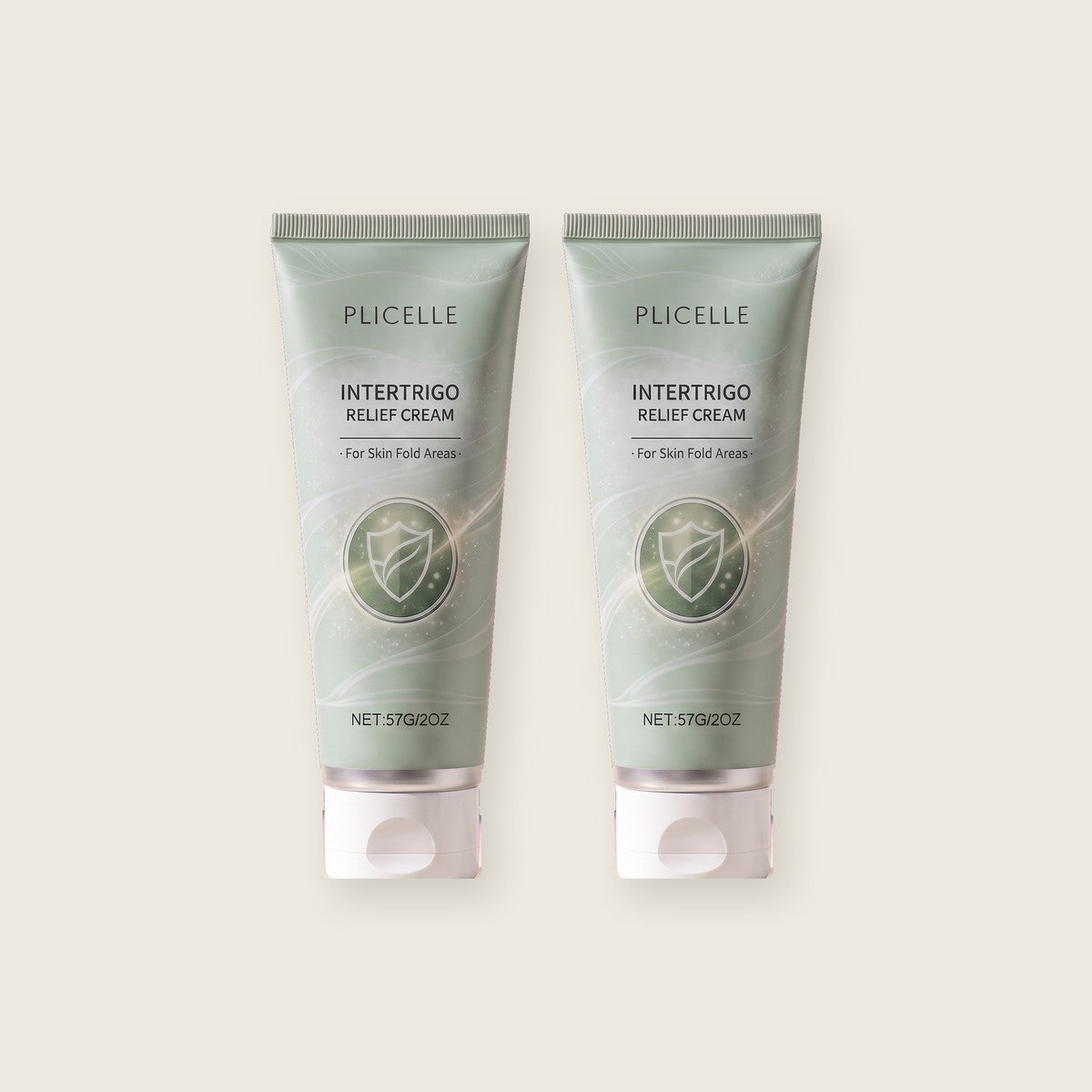
INTRODUCING PLICELLE INTERTRIGO RELIEF CREAM

Plicelle is a cream made for skin fold areas. It is built on zinc oxide and undecylenic acid, and it is made to do three jobs in the fold at once: dry the moisture, fight the yeast, and prevent the chafing.
You put it on after your shower. You let it dry. You get dressed.
✓ MADE FOR SKIN FOLD AREAS: under the breasts, the underarms, the inner thighs, and anywhere else skin rests on skin.
✓ DRIES MOISTURE: it supports a drier, more comfortable fold, which is the one thing powder promised and could not keep up.
✓ FIGHTS YEAST: with undecylenic acid, the antifungal ingredient.
✓ PREVENTS CHAFING: zinc oxide helps form a lightweight protective layer between the two skin surfaces, so skin stops rubbing on skin.
✓ LIGHTWEIGHT AND NON-GREASY: a smooth white cream that spreads easily into the crease and dries to a comfortable dry finish.
✓ WON'T STAIN CLOTHING: let it dry before you dress and it stays off your bra and your blouse.
✓ ONCE A DAY: a thin layer on clean, dry skin, as part of your morning routine. Each tube is 2 oz (57 g).
No paste by lunchtime.
No hairdryer.
No folded tissues under your bra.
No prescription.
WHAT WOMEN NOTICE

When something takes thirty seconds after your shower and lets you get dressed straight away, you do it. And when you do it every day, here is what women describe.
The first morning: a dry fold. Most women notice it within a few minutes of putting it on. The crease feels dry to the touch instead of tacky, and it is still dry when they check at lunchtime.
The first days: less sting. Many tell us the burn when they sweat and the itch in the evening ease first, and that taking their bra off at night stops being the worst moment of the day.
The first weeks: no smell. Women who use it daily describe the sour smell not coming back after the shower, and going a whole warm day without thinking about the fold at all.
After that? It becomes thirty seconds of the morning, like brushing your teeth.
Individual experience varies, and the women below are describing theirs.
WHAT WOMEN ARE SAYING


"I'm 68. I had been tucking a folded handkerchief under each breast for four summers because of the rash. I put this on after my shower and get dressed. I checked at lunchtime the first day and the skin fold was dry. I have not used a handkerchief since."
"Nobody ever told me the rash under my belly had a name. I honestly thought I was not washing properly. Reading what a skin fold rash actually is made more sense to me than anything a doctor had said in ten years."
"The diaper cream I was using ruined three good bras. This dries and you cannot see it. It does not come off on my clothes. The under-breast rash stopped stinging in the first week."
"Arizona in July with a skin fold rash is a misery. I had a drawer of powders. This is the first thing I have used every single day, because it takes half a minute and I can dress right after."
WHAT THE SKIN FOLD RASH HAS ALREADY COST YOU

Let me show you what the usual route costs, because I sent women down it for 31 years.
The Powder Route:
- A bottle every few weeks, every summer, for years
- Dry for an hour, paste by lunchtime
- White marks on every dark top you own
The Cream Aisle Route:
- Anti-itch cream, antifungal cream, diaper paste: $8 to $15 a tube, and most women own five
- Better for a few days, then back
- Bras stained beyond saving
The Appointment Route:
- A co-pay and a morning in a waiting room
- Ten seconds of looking and "keep it clean and dry"
- A prescription that works while you use it
I am not telling you any of those were wrong. Each was working on a part of it. Nobody put the drying, the yeast and the barrier together, in something you can get dressed over, every day.
The regular price for two tubes of Plicelle is $138.
But that is not what you will pay today.
WHY WE SEND TWO, AND CHARGE FOR ONE
A skin fold rash is not a one-week problem. The fold is still a fold next month, and it will be warm again.
The women who do best are the ones who keep using it every morning after the skin has calmed down, the way you keep brushing your teeth after the dentist. That takes more than one tube. And nearly everyone who wrote to us wanted one for the bathroom and one for the travel bag.
So the offer on this page is two. Buy one tube, and the second is free.
Today that is $69 for two. $34.50 each.
- Less than one visit to the doctor about it.
- Less than the bras the pastes have already ruined.
- Less than the powders and creams in your drawer right now.
For a cream made for the skin fold, that dries, fights the yeast and stops the rubbing, every morning, in your own bathroom.
LOOK, I UNDERSTAND THE SKEPTICISM
You have been down this road. You have a drawer of things that were supposed to help. You have been told "keep it dry" by people who never said how.
So here is my promise, and it is the only promise on this page:
Use it for 90 days. If you are not glad you bought it, email us and we refund every penny.
- No forms.
- No "store credit".
- No questions you do not want to answer.
Why am I comfortable making that offer? Because zinc oxide and undecylenic acid are not new or strange. Nurses have reached for both for decades. All that has changed is that they now come together in a cream made for the fold, that dries, and that you can dress over.
Support: support@plicelle.com
BUT HERE'S THE CATCH
The buy-one-get-one pricing on this page is for readers of this article, and we review it every week based on stock.
Our current batch is 6,000 tubes. A batch takes weeks to make and fill, and with most orders being two, four or six tubes, a batch does not last long.
We do not sell on Amazon. This page is the only place the two-for-one pricing exists.
If you are reading this, the two-for-one pricing is still available.
I cannot promise it will be tomorrow.
And here is the thing...
Every day you wait is another day:
- The skin fold sits wet from mid-morning
- Softened skin rubs on softened skin
- The yeast in the fold has everything it needs
While thirty seconds after your shower costs $69 for two tubes.
THE CHOICE THAT DECIDES WHAT NEXT SUMMER FEELS LIKE
Right now, you are at a fork.
Path #1: Keep Managing The Rash
Keep powdering. Keep the hairdryer by the sink. Keep the folded tissues, the dark tops and the cardigan in July. Keep checking the skin fold every time you go to the bathroom.
Path #2: Go After What Is Happening In The Skin Fold
Spend less than one doctor's visit on two tubes, put a thin layer on after your shower, and check the fold at lunchtime.
The choice seems pretty obvious to me.
HERE'S EXACTLY WHAT TO DO NEXT
- 1. Click the button below that says "Check Availability Now →"
- 2. Choose your pack. (Most women choose the two: one for the bathroom, one for the bag.)
- 3. Fill in your shipping details. Orders ship within one business day.
- 4. When it arrives, wash and dry the skin fold, apply a thin layer, and let it dry before you dress.
- 5. Check the fold at lunchtime. Then email us and tell us. We read every one.
But whatever you do, don't close this page thinking "I'll order later."
Later is another summer of powder turning to paste.
Later is another bra in the bin.
Later is this batch being gone.
You were never unclean. The skin fold was wet, and nothing you were given could dry it.
Click below and put the powder away.
EARLY BLACK FRIDAY OFFER
FOR A LIMITED TIME:
BUY ONE, GET ONE FREE + FREE US SHIPPING
LIMITED TIME READER-ONLY SPECIAL:
Ordering from this page gets you two tubes for $69, free US shipping, and the 90-day money-back promise above.
With respect, and a dry skin fold,
Carol Whitaker, RN
Wound & Skin Care Nurse (retired), Plicelle
P.S. I use mine every morning after my shower, under both breasts. Last August I wore a white linen blouse to my granddaughter's outdoor graduation, in 94 degrees, and did not think about the fold once.
P.P.S. Try this tomorrow. Powder as usual in the morning, then look at the skin fold at noon. If what you find is a damp grey paste in the crease, you have seen for yourself why the rash keeps coming back.
P.P.P.S. The two-for-one pricing is reviewed weekly against stock. The button below is the only place it exists.